Stop solving the same incident twice.
Your team already solves hard problems every week. Stackbridge turns the tickets and threads they produce into a knowledge base that writes itself, so nothing has to be solved, answered, or learned twice.
- Deployed on your infrastructure
- Your data never leaves it
- Bring your own LLM
Running in production today at
maya
checkout is down, customers can't pay 😱 anyone know why?
tom
started right after the 2pm release i think
maya
we hit something like this months ago too?
sam
can't find the old thread anywhere 🙄
tom
rolled back the release, payments working again ✅
… then it's gone
Checkout went down after a release
- What happened
- A broken setting in the 2pm release stopped customers from paying.
- How it was fixed
- Rolled back to the previous release.
- How to prevent it
- Block a release automatically if checkout can't complete a test payment.
searchable forever
Try it on your own thread further down the page.
Connects to the stack your team already lives in
Every repeated incident is a problem someone on your team already solved. Every resignation walks the answer out the door.
Twice
How many times you pay for the same incident. Once when it happens, and again when it happens to someone who wasn’t there the first time.
One
How many people have to leave for the only real account of how something works to leave with them.
3am
When you find out whether last time’s fix was ever written down, or just typed into a thread and forgotten.
Your team already solved it. Nobody can find it.
Every IT organisation loses knowledge it has already paid for. It happens in three ways. None of them look like a crisis on the day they happen, which is exactly why they go unfixed for years. Most teams recognise at least two of these immediately.
The same incident, twice
It was fixed at 3am, eight months ago. Whoever fixed it wrote the answer in a thread nobody can find now. So the next outage gets solved from scratch, at the same cost, by someone else.
You pay for the same outage twice
Knowledge that walks out the door
A senior engineer resigns and the undocumented half of your platform leaves with them. Nothing was ever hidden. It just never got written down, and four weeks of notice is not long enough to reconstruct nine years.
Months of ramp-up. One person, single point of failure.
The same question, forever
What is the proxy? Who owns this cluster? How do I get access? Answered in chat again and again by whoever is senior enough to know. It is an interrupt tax, and it is paid by exactly the people you can least afford to interrupt.
Your best engineers, answering the same question
Stackbridge exists to stop all three. It captures what your team works out, structures it while the context is still fresh, and puts it back in front of the next person who needs it. Your knowledge stops depending on who happens to still be in the room.
Chaos in. Memory out.
Four moving parts. One of them is a person, and none of them is extra work for your team.
Connect your stack
Point Stackbridge at Jira, Slack, Teams, Confluence, GitHub or Bitbucket. Tickets and threads flow in on their own. Your team changes nothing about how they work.
Your LLM structures it
Every messy thread becomes a typed entry: what broke, how it was fixed, how to stop it happening again. Your choice of model: Claude, OpenAI, or one running on your own hardware.
A human approves it
Nothing enters the knowledge base on the AI’s say-so. Everything lands as a draft for review. Approve or reject from the web app or straight from the Slack thread, with every action attributed.
It finds the engineer
Ask in plain English and get the exact past fix, not a link to a thread nobody has time to read. When a repeat incident lands, Stackbridge posts the closest match into the channel before anyone thinks to ask.
Watch it happen, four ways.
Knowledge gets in from the tools your team already uses, and you can run each path here. Pasting is the fallback, not the plan.
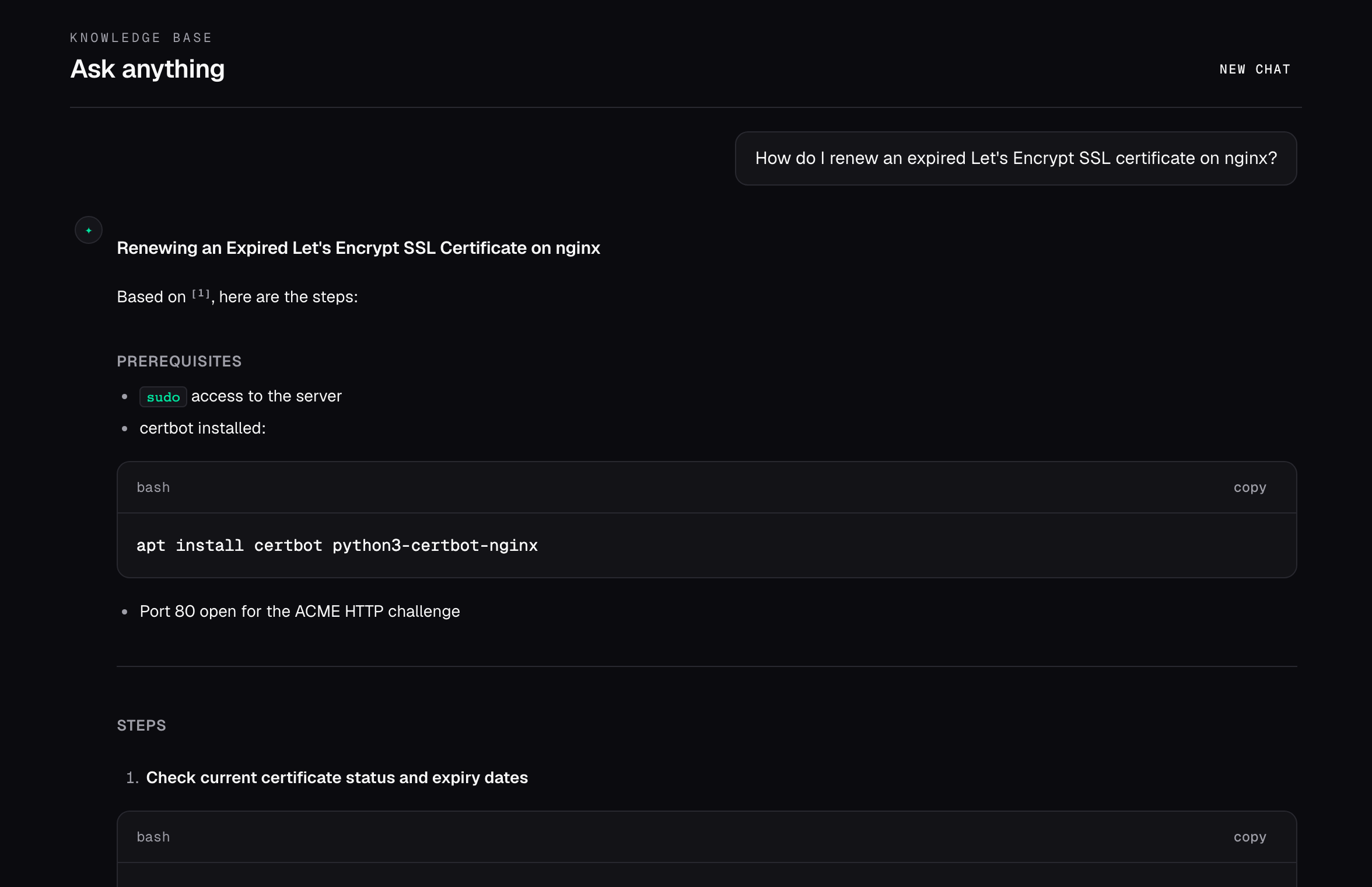
Ask a question. Get the answer your team already found.
Grounded in your own incidents and runbooks, with the entry it came from cited, so the person reading it at 3am can check it. Screenshots of the running product, not comps.
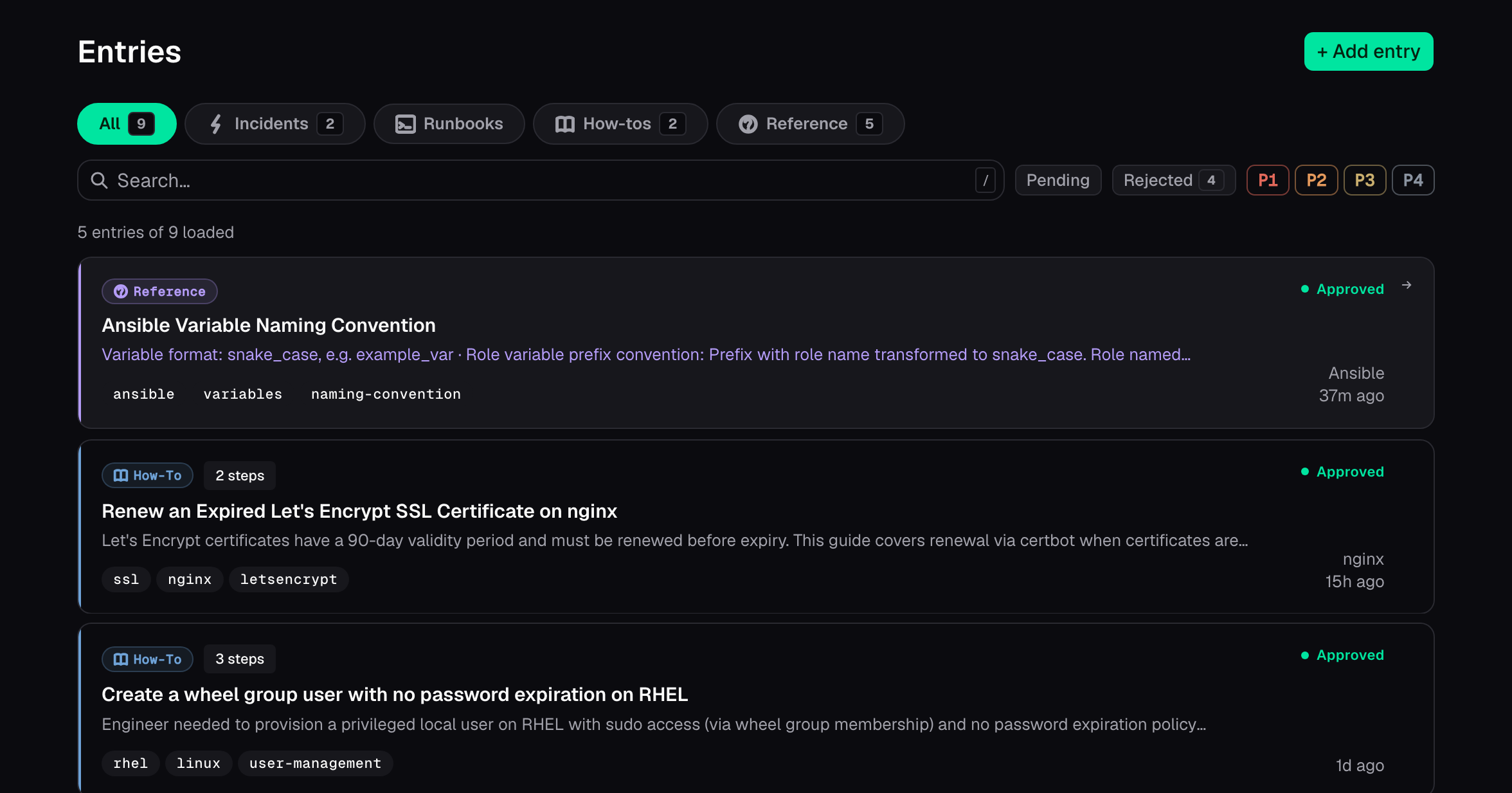
Everything your team knows, working for you
Nine things a wiki cannot do, because a wiki does not know an incident happened.
Semantic search
Ask in plain English or paste the raw error. Get back the specific incident that matched, the fix that worked, and who found it. Not a list of documents you still have to dig through.
Proactive matching
New incident lands? Stackbridge posts the closest past fixes into the thread before anyone has to ask.
Structured, not dumped
Every fix lands in a typed schema with severity, service, and error signature. No free-text dumps nobody can find when it actually matters.
Auto runbooks
When the same error keeps coming back, one click turns every past occurrence into a runbook for that service, so the next on-call engineer inherits a playbook instead of a blank page and a pager.
Survives attrition
When a senior engineer leaves, their fixes stay, and so does the reasoning. Decision records capture why it was built this way; service cards capture who owned it and what breaks.
Answers where you already are
Ask in Slack or Teams without opening a tab. Or from inside Claude Code and Cursor. Stackbridge speaks MCP, so your coding agent can search past incidents and file new ones itself.
Knows what it doesn't know
Every unanswered question is logged and clustered. You get a ranked list of the knowledge you're missing, plus an AI-guided interview to get it out of the person leaving on Friday.
Audit & compliance
Versioned, attributed, logged, exportable. The paper trail auditors ask for, without anyone having to produce it.
One knowledge schema · six entry types
“But Rovo already does this.”
It searches what somebody already wrote down, which is a different job from making sure it got written down at all. Here is the honest difference between the four things a team reaches for when the pager goes off, including the last row none of them can answer.
Who has to write it down?
Stackbridge
Rovo · Copilot · Glean · Nobody, but it can only surface what someone already wrote
Wiki / Confluence · A person, after the incident, on their own time
Slack search · Nobody, but nothing is written either
Is it still true in six months?
Stackbridge
Rovo · Copilot · Glean · Indexes what is there, including the page that went stale
Wiki / Confluence · Rots quietly from the day it is published
Slack search · Accurate, but scrolled past retention
Can you find a fix from a symptom?
Stackbridge
Rovo · Copilot · Glean · Strong search, if somebody documented the fix at all
Wiki / Confluence · Only if you guess the words someone titled it
Slack search · Keyword-only, and the fix is 200 messages down
Does it reach you during the incident?
Stackbridge
Rovo · Copilot · Glean · You have to stop and go ask it
Wiki / Confluence · Sits in a tab nobody opens at 3am
Slack search · You are already in it, and still searching
Can it run with no internet egress?
Stackbridge
Rovo · Copilot · Glean · VPC and regional options exist, but the vendor still operates it
Wiki / Confluence · Data Center edition, at Data Center prices
Slack search · SaaS only
Does it tell you what it is missing?
Stackbridge
Rovo · Copilot · Glean · Returns its best guess and stops
Wiki / Confluence · No idea what was never written
Slack search · No
Can you prove who approved a fact, and that it was not altered?
Stackbridge
Rovo · Copilot · Glean · Indexes everything; nothing is reviewed or approved
Wiki / Confluence · Page history, editable by anyone with edit rights
Slack search · No
| Stackbridge | Rovo · Copilot · Glean | Wiki / Confluence | Slack search | |
|---|---|---|---|---|
| Who has to write it down? | Nobody. It reads the ticket and the thread | Nobody, but it can only surface what someone already wrote | A person, after the incident, on their own time | Nobody, but nothing is written either |
| Is it still true in six months? | Confluence re-syncs hourly; repos version-diffed on demand | Indexes what is there, including the page that went stale | Rots quietly from the day it is published | Accurate, but scrolled past retention |
| Can you find a fix from a symptom? | Semantic search plus exact error-signature match | Strong search, if somebody documented the fix at all | Only if you guess the words someone titled it | Keyword-only, and the fix is 200 messages down |
| Does it reach you during the incident? | Posts the closest past fix into the thread, unasked | You have to stop and go ask it | Sits in a tab nobody opens at 3am | You are already in it, and still searching |
| Can it run with no internet egress? | On-premises via Helm, local model, no inbound ports | VPC and regional options exist, but the vendor still operates it | Data Center edition, at Data Center prices | SaaS only |
| Does it tell you what it is missing? | Ranked gap report from every unanswered question | Returns its best guess and stops | No idea what was never written | No |
| Can you prove who approved a fact, and that it was not altered? | Named approver, hash-chained audit trail, per-entry read log | Indexes everything; nothing is reviewed or approved | Page history, editable by anyone with edit rights | No |
Your knowledge, inside every AI tool
Connect Claude Code, Claude Desktop, Cursor, or any other MCP client. One command, a browser login, done. No tokens to copy, org-scoped by design.
- Pull your team's real incident fixes, cited and attributed, right into your chat
- Solved something new? Your agent files it back in one sentence
- Self-hosted with Stackbridge, so your knowledge never leaves your network
$ claude mcp add stackbridge \
https://sb.acme.com/mcp
✓ Authenticated as you@acme.com
you › why did checkout go down after the release?
claude › Your team hit this in March. A broken setting in the release stopped payments. Fix: rolled back the release. Here's the runbook
Your knowledge never leaves your walls
Written for the security review, not around it. This is the section your CISO will read first, so it is the one we made most specific.
Fully on-premises deployable
Run entirely inside your own infrastructure via Helm on your Kubernetes, fully air-gapped if needed. Nothing leaves your network.
No training on your data
Your incidents and fixes are never used to train models. Your knowledge stays yours, and the export button gives all of it back at any time.
Bring your own model. No lock-in.
Claude, OpenAI, or a local model on your own hardware. Chat and search can even run on different machines, so a shared GPU box handles the heavy model while embeddings stay next to the app.
No inbound ports. Not even for Slack.
Slack normally needs a public URL to call into. Stackbridge dials out instead and holds the connection open, so the full Slack integration works with nothing exposed to the internet at all.
The paperwork, already done
A one-click export of your approved knowledge and its complete audit trail, tamper-evident so an auditor can verify nothing was edited after the fact, SSO through Entra ID, Google or GitHub, and role-based access down to read-only.
A human gate on everything
The AI proposes; a person approves. Nothing reaches the knowledge base unreviewed, and every approval carries a name and a timestamp.
For regulated environments
Built to survive your auditor, not to dodge them
Stackbridge is not itself ISO 27001 certified. That certifies an organisation, not a product. And no software can be “NIS2 compliant” on your behalf, because NIS2 obligates you, not your vendor. What we can do is answer the questions your auditor will actually ask, and show the code behind each answer.
So we keep a written control mapping against ISO/IEC 27001 Annex A and NIS2 Article 21(2) that states the gaps as plainly as the coverage, and we send it to anyone evaluating us. If a vendor’s security page has no gaps on it, you are reading marketing.
- Role-based access with privileged actions separated and logged
- Removing someone revokes their sessions and their AI-tool grants
- Integration credentials encrypted at rest, with documented key rotation
- Full audit trail of who changed what, exportable on demand
- Runs entirely inside your perimeter, air-gapped if you need it
- A published vulnerability disclosure route with stated timelines
One repeat outage costs more than a year of this.
A single repeat P1, conservatively
- 6 engineers pulled onto the call
- × 5 hours before anyone finds the old fix
- × €95 fully-loaded hourly cost
- Payroll alone
- €2,850
Before the customers who noticed, the release you had to freeze, and the post-mortem that fixed nothing. We price against that number, not per seat, and we would rather you judged us on repeats prevented.
You don't have to take our arithmetic. Stackbridge computes this against your own approved incidents (real repeat-prevention and real LLM cost avoided) on a page inside the product. Your numbers, not ours.
Quoted per deployment, not per seat.
What you pay depends on the size of your team, how many sources you connect and the support you want. Nothing is priced per user, so the number does not move when the team grows.
On-premises
Deployed on your own Kubernetes via Helm, air-gapped if you need it, running a model you choose. Your knowledge never leaves your network.
- Your infrastructure, your model
- No inbound ports required
- Air-gapped installs supported
- Installed with you, not shipped as a download
Hosted
If starting on your own infrastructure is not practical yet, we can talk about hosting it for you in the EU. It is a conversation, not the default.
- EU-hosted
- Same product, same integrations
- A path onto your own infrastructure later
- Discussed case by case
Included either way
- Every integration
- Unlimited users
- SSO with Entra ID, Google or GitHub
- Audit log and GDPR export
- Semantic search, runbooks and MCP
- Bring your own LLM
Every engagement starts the same way: a 20-minute call on one of your own incidents, then we connect your first integration with you. No credit card, no self-serve maze, no sales cycle. You will have a number before the second call.
The questions buyers actually ask
Stop losing what you already paid for.
Bring one real incident from the past month. In 20 minutes we'll show you what your team would have found in seconds instead of hours. You keep the answer either way, and there is no second call unless you ask for one.
We built Stackbridge because we were the ones being paged. Every install is set up with you, on your infrastructure, by the people who wrote it. That is also why we take on a limited number each quarter.
Already running Stackbridge? Sign in at your own install's address. We never hold your knowledge base.